Introduction
In the business, the term “net zero” has shifted from a niche aspiration to a boardroom imperative; still, many companies struggle to turn their claims into measurable action. The era of voluntary climate ambition is over; we have entered the Climate Decade, an age of regulation, scrutiny, and momentous market differentiation. For businesses inclined toward long-term survivability and growth, the question is no longer whether to decarbonize or not but how to do so credibly. The answer involves adopting a compliance-first Net Zero Pathway as defined by SBTi, converting environmental commitments into a strategic, science-grounded business plan, and aligning your ESG efforts with tangible risk management.
The 1.5°C Countdown: The Non-Negotiable Math
Before charting your pathway, you must recognize the scale of the challenge. The IPCC states that, in order to limit warming to 1.5 °C, global emissions must peak by 2025 and, by 2030, be reduced by about 43 %.
Illustration 1: The Rapid Decarbonization Imperative
Source: IPCC AR6 Synthesis Report, 2023
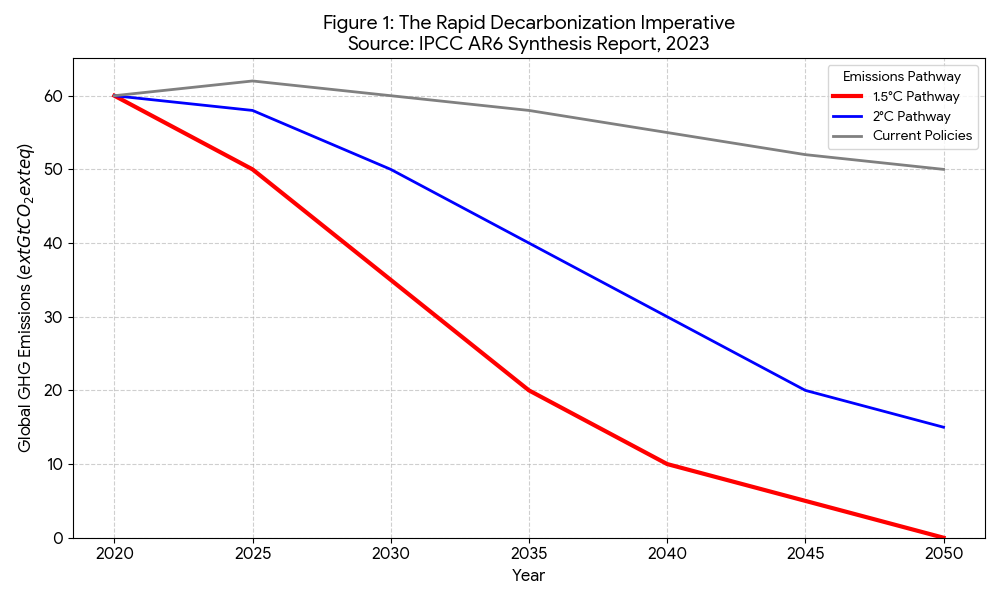
The SBTi’s Pathways to Net-Zero framework translates this global carbon budget into actionable corporate targets: companies must strive to reduce ≈ 42 % of absolute emissions by 2030 and around 90 % by 2050 across Scopes 1, 2 and 3.
Demystifying a Credible Net Zero Pathway
A net zero pathway refers to a time-bound, detailed path upon which an enterprise can reduce its GHG emissions in accordance with climate science and reach a state where its emissions released are balanced by emissions being permanently removed. Importantly, this is not an offset-first model. Under the SBTi Corporate Net-Zero Standard, companies should pursue deep, absolute emissions reductions across the full value chain (Scopes 1, 2, 3) before offsetting. Only when companies reduce ~90% of residual emissions by 2050 can the remaining <10% residual emissions be neutralised through high-integrity removals.
The Net-Zero Standard: A Compliance Roadmap
The SBTi Corporate Net-Zero Standard provides the only globally recognised framework that lays out criteria for corporate net-zero target setting aligned with 1.5 °C pathways. Key elements for your company to adopt include:
- Comprehensiveness of GHG inventory: Companies shall account for at least 95% of scope 1 & 2 emissions and conduct a full screening of scope 3.
- Clear boundaries: In the near term, targets must cover at least 95 % of scope 1 and scope 2; further, if the scope 3 forms ≥40% of the total emissions, then at least 67% of those should be included. Long-term targets must cover ~90 % of scope 3 emissions.
- Target structure: Near-term science-based targets for 5-10 years, long-term targets to reach net-zero by 2050 (or earlier), and neutralisation of residual emissions through permanent removal only.
- Beyond Value Chain Mitigation: Complementing the value-chain reduction, companies are encouraged to invest in emissions removal/reduction outside their immediate value chain as a means of deepening impact.
- Transparency, validation & accountability: Targets are to be publicly committed, submitted for SBTi validation, progress reported annually, and claims substantiated.
From Framework to Action: Setting Your Target and Building a Decarbonization Roadmap
Ascertaining the what and the why are just the first steps; the critical next phase is execution. Here’s a practical way to set your target and develop the actionable roadmap to achieve it:
- Develop a Granular GHG Inventory: This is the most critical non-negotiable foundation. Go beyond estimates to primary data collection for Scope 1 & 2; for Scope 3, do a comprehensive screening to identify the top-emitting categories, such as purchased goods and logistics.
- Set the Baseline & Model Scenarios: Agree on one base year. Take this information to model various ambition levels against SBTi sectoral pathways, enabling the determination of the pace of reduction needed.
- Define Target Boundaries and Ambition: Determine which operations, subsidiaries, and Scope 3 categories your near-term and long-term targets will include, ensuring they meet SBTi’s minimum thresholds. Determine whether to use an absolute reduction or an intensity-based target according to your growth trajectory.
- Identify & Prioritize Abatement Levers: This forms the heart of your roadmap. For each emission scope, identify discrete reduction projects, such as renewable energy procurement, fleet electrification, material efficiency, and supplier engagement programs. Rank them based on abatement potential, cost, and feasibility.
- Integrate into Business Strategy: A target is not an ESG initiative; it’s a business transformation. Allocate capital expenditure, assign clear ownership to business units (Procurement, Operations, R&D), and link KPIs to performance reviews.
- Validate & Communicate: Submit your targets for formal validation to SBTi. An independent stamp of approval is important for credibility. Then communicate the validated targets publicly to stakeholders.
- Implement, Monitor, and Iterate: Execute the roadmap with regular progress tracking against your targets. Put in place a sound governance structure-e.g., a steering committee-that will review progress quarterly and resolve blockages, and amend the plan as necessary.
Why Compliance Matters for Carbon Accounting & GHG Professionals
These days, in the era of heightened climate scrutiny, the role of Carbon Accounting and GHG professionals has changed radically. They are now strategic architects who build their clients’ credibility and competitive resilience. Given this, adopting a compliance-first approach to the SBTi Net-Zero Standard can arguably be one of the most powerful ways to elevate impact from reporting to strategic foresight. Key benefits:
- Demonstrates the alignment with a robust, external standard to increase investor and stakeholder confidence.
- Helps avoid greenwashing risk by ensuring deep cuts rather than offset-heavy claims.
- Elevates Carbon Accounting from a Silo to a Strategic Dashboard.
- Puts companies ahead of regulatory expectations as corporate disclosure standards globally continue to align with SBTi-style frameworks.
Conclusion: From Pledge to Proven Pathway
The time for vague net-zero promises is over; the price of entry is now credible, science-based pathways. Aligning with the SBTi Corporate Net-Zero Standard isn’t about building a robust climate strategy; it’s about future-proofing your business in an age of accountability. No longer is the question if you will embark on this journey, but how swiftly and rigorously you will execute it. Transiting from pledge to proven pathway requires a clear step-by-step plan, deep integration into business operations, and unwavering commitment.
Ready to turn your SBTi ambition into a validated, actionable plan? Contact us to learn how we can help verify your targets or to build a comprehensive, business-integrated decarbonization strategy.
Sources:
- IPCC (Intergovernmental Panel on Climate Change) AR6 Synthesis Report: https://www.ipcc.ch/report/sixth-assessment-report-cycle/
- Science Based Targets initiative (SBTi): https://sciencebasedtargets.org/
- GHG Protocol Corporate Standard: https://ghgprotocol.org/corporate-standard
- IFRS S2 Climate-related Disclosures: https://www.ifrs.org/issued-standards/ifrs-sustainability-standards-navigator/ifrs-s2-climate-related-disclosures/
- CDP (Carbon Disclosure Project): https://www.cdp.net/